
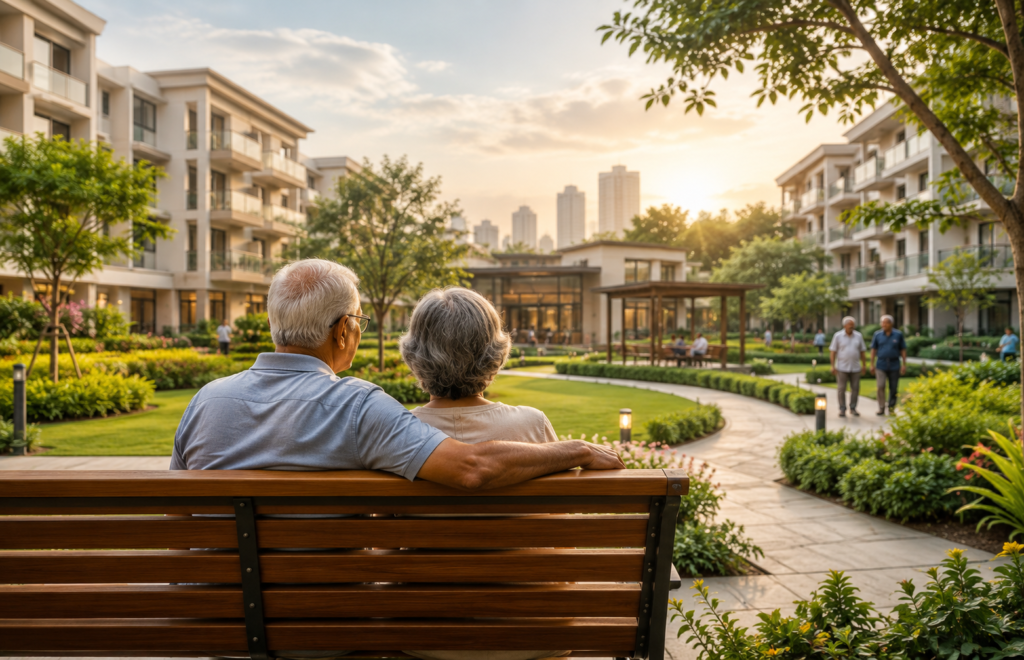
My grandfather used to say retirement means “sitting at home and waiting for evening tea.” That was true for his generation, maybe even for my parents’ generation. But somewhere in the last few years, I have noticed this idea quietly breaking apart. The more I talk to families around me, the more I realise retirement in India is turning into something nobody really prepared us for – and honestly, it’s a good change.
I started paying attention to this topic after helping my aunt look for a place for my grandmother, who lives alone in Nagpur. That search opened my eyes to how much this space has changed, and where it’s headed.

Retirement Used to Mean “Staying Put.” Not Anymore.
For decades, the retirement plan in most Indian families was simple – stay in the same house, hope children visit often, and depend on neighbours for company. Nobody really talked about moving somewhere new after 60. It felt almost disrespectful to even suggest it.
But that mindset is shifting fast. Today, more seniors are choosing to move into dedicated senior living residences, not because their families don’t care, but because these spaces are actually designed around how older adults want to live – safely, socially, and without constantly depending on someone else for every small task.
What’s Actually Changing (From What I’ve Observed)
1. Independence Is Becoming the New Priority
Earlier, moving in with children after retirement was seen as the “responsible” choice. Now, many seniors openly say they want their own space, their own routine, and their own friend circle – without feeling like a burden on their children’s daily life. This shift toward independence is, in my view, the biggest change happening quietly across Indian households.
2. Health Support Is No Longer an Afterthought
I remember my grandmother’s biggest fear was not loneliness; it was “what if something happens at night and no one is around?” That one fear is exactly what’s pushing families toward planned senior living residences – places built with health support close by, not as a separate hospital visit away.
3. Community Is Replacing Isolation
This is something I didn’t expect to notice, but it stood out clearly. Seniors living in shared residential communities seem far more active – morning walks together, evening card games, small festivals celebrated as a group. Compare that to a senior living alone in a big empty house, and the difference in mood and energy is not subtle at all.
4. Design Is Finally Being Built Around Seniors, Not Just Families
Older homes in India were rarely designed with ageing in mind – stairs everywhere, slippery bathroom floors, poor lighting. Newer senior living residences are flipping this completely, with layouts that actually think about mobility, safety, and comfort from day one, instead of adjusting an old house after an accident happens.
5. Children Are Becoming More Involved, Not Less
Here’s an insight that surprised me the most. I assumed this shift meant children were “outsourcing” care. In reality, most families I spoke to remain deeply involved – visiting often, staying updated, just no longer being the only support system available at 2 AM. If anything, the relationship feels lighter and warmer, not distant.
Why This Shift Makes Sense for India Specifically
India’s family structure is changing quickly. More children move to cities or countries for work. Nuclear families are now common even in smaller towns. In this reality, expecting one family member to manage everything for an ageing parent alone is simply not practical anymore. Planned senior living residences are stepping into this exact gap – not replacing family, but supporting it.
Brands like Bigchamps have understood this shift early, focusing not just on building structures, but shaping how everyday life feels for seniors – from daily routine to social connection. Having followed a few such projects closely, what stands out is the attention given to lifestyle design, not just construction.
What I Personally Think Will Happen Next
If the current pace continues, I believe senior living residences will stop being seen as a “last resort” option and start becoming a proactive choice – something people plan for in their 50s, not something families scramble to arrange after a health scare. Retirement, I think, is finally being seen as a phase to live fully, not just to manage carefully.
Final Thought
My grandfather’s “sit and wait for evening tea” idea is slowly fading, and I don’t think that’s a loss. If anything, this new version of retirement – active, social, supported – feels closer to what most seniors actually want, once they get a taste of it.
Frequently Asked Questions
1. What exactly are senior living residences?
These are residential communities specifically designed for seniors, keeping their daily comfort, safety, mobility, and social life in mind, rather than a general housing setup.
2. Is moving to a senior living residence the same as an old age home?
No, and this is a common confusion. Senior living residences are chosen actively by families for independence and lifestyle, unlike traditional old age homes, which are usually associated with limited family involvement.
3. Do children stay involved once a parent moves to a senior living residence?
In most cases, families stay just as involved, sometimes even more, since visits become more relaxed and less driven by daily caregiving stress.
4. Why is this shift happening now in India specifically?
Changing family structures, more children relocating for work, and growing awareness about senior-specific health needs are the main reasons behind this shift.
5. At what age should someone start considering senior living options?
There’s no fixed age, but many experts suggest planning early, around the late 50s, so the move feels like a proactive lifestyle choice rather than a reactive decision after a health issue.