
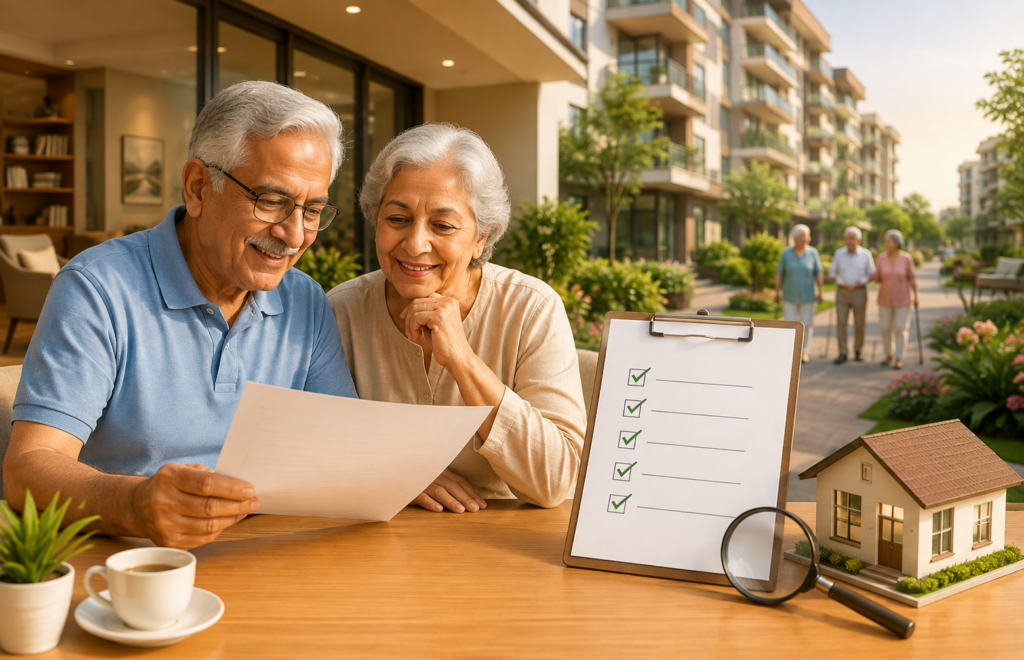
Every second family in Delhi NCR is having this conversation right now. Papa is turning 62, the Gurgaon flat has three floors and no lift, and somebody at a dinner party mentioned “retirement homes for sale near me” like it’s a magic phrase that solves everything.
Let us get one thing out of the way first, because this confusion trips up almost every family we meet. A retirement home is not an old-age home. These two get lumped together so often that people walk into site visits with entirely the wrong expectations.
An old-age home is a care facility. Someone else runs your day, your meals, your schedule. A retirement home, done properly, is the exact opposite. It is your own house, your own keys, your own choice to sleep till 10am or join the morning walk group at 6. Nobody is managing you. The property is simply designed around the fact that a 65-year-old and a 30-year-old have different needs from their staircase, their bathroom, and their neighbourhood.
At Bigchamps, this is the line we keep drawing for families, again and again, because it matters more than any brochure feature.
Why This Search Is Suddenly Everywhere
Three things changed in Indian families over the last ten years.
Children moved abroad or to other cities for work – this isn’t news to anyone reading this. Second, the joint family setup, where three generations lived under one roof and looked after each other by default, has thinned out in most urban homes. Third, and this one surprises people, today’s 60-somethings are not interested in “settling down” in the way their parents were. They want a second innings. Travel, hobbies, a badminton court, friends their own age who understand what a knee replacement feels like.
So the search for retirement homes for sale near me isn’t really about finding a smaller house. It’s about finding a life that fits the next 20-25 years, not the last 20-25.
What Seniors Should Actually Check Before Buying
Here is where most articles online give you a checklist copied from a real estate portal. We have sat across the table with hundreds of families over the years, and the questions that actually matter are rarely the ones people ask first.
1. Who is really designing this for age, and who is just adding a ramp?
Anyone can put a ramp at the entrance and call it senior-friendly. Ask harder questions. Are the bathroom floors genuinely non-slip, or just marketed as non-slip? Are the switches at a height that doesn’t need bending or stretching? Is there a grab rail near the shower, or will you be adding one yourself after moving in? Walk the property. Sit on the toilet seat, literally, and check the height. These small centimetres decide whether you fall or don’t, ten years from now.
2. What happens on the day you need a doctor at 2am?
This is the question families avoid asking because it feels heavy. But it’s the most practical one on this entire list. Is there a tie-up with a hospital, and how far is it actually – not on Google Maps in ideal traffic, but in real Delhi NCR traffic at odd hours? Is there an emergency response system inside the home itself, something a senior living alone can press without fumbling for a phone? Get this in writing, not in a sales pitch.
3. Community, not just construction
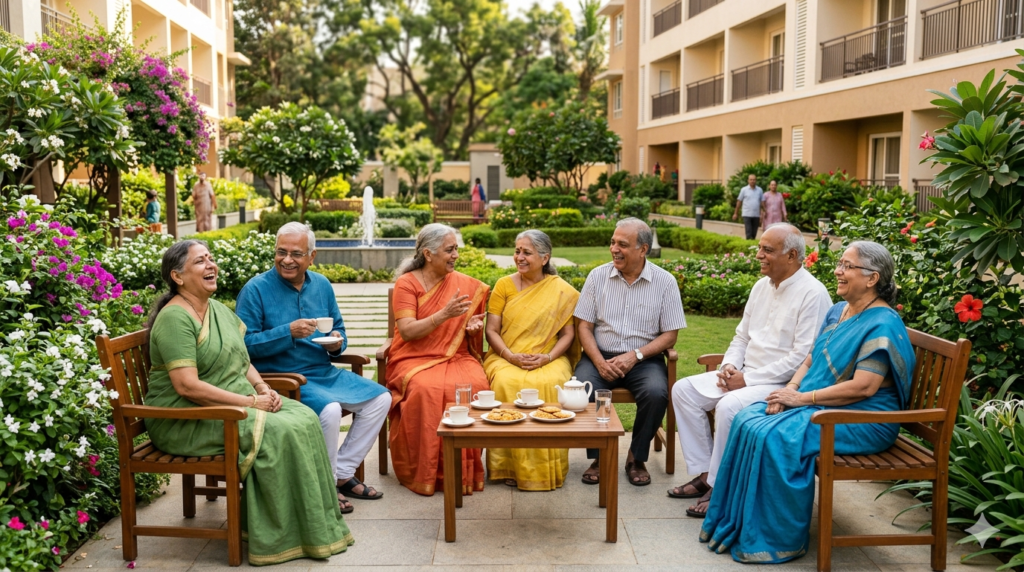
A retirement home succeeds or fails on the people inside it, not the marble in the lobby. Visit during the day, not just for the sales appointment. See if residents are sitting together, chatting, playing cards, using the common areas. A retirement project with beautiful architecture and empty common spaces tells you something important – people bought the flat and went back to isolation. That defeats the entire purpose.
4. Resale and long-term value
Families rarely think about this until it’s too late. If circumstances change – health, finances, a child finally wanting the parent to move closer – can this property be resold easily? Retirement housing in India is still a young category, and not every project has a proven track record of resale. Ask for actual data, not assurances.
5. Maintenance costs, told honestly
Every project quotes a maintenance figure during the sale. Ask what it covered five years ago versus today. Costs for senior-focused amenities – the medical desk, the activity coordinator, the housekeeping support – tend to rise faster than standard apartment maintenance. Budget for that rise, don’t get surprised by it.
6. Location that keeps you connected, not isolated
A retirement home in a far-off, cut-off location might look peaceful in the brochure photos, but ask yourself honestly – will your children visit easily on a Sunday? Will you be able to reach a good hospital, a market, a temple or gurdwara, without depending entirely on someone else driving you? Delhi NCR has good options within reasonable distance of the city. You don’t have to trade connection for calm.
Read Also: Retirement Checklist: 25 Things to Do Before You Retire
The Bigchamps Way of Looking at This
We built Bigchamps on a simple belief – retirement should feel like arrival, not withdrawal. So many projects sell peace and quiet as the main selling point, as if the goal of aging is to disappear quietly into a garden somewhere. We don’t see it that way.
Our residents include a former bank manager who now runs a small terrace garden that the whole community eats vegetables from. A retired schoolteacher who started an informal Hindi poetry evening that now has a waiting list to join. These aren’t things we planned on a brochure – they happened because the space, the neighbours, and the freedom allowed them to happen.
That is the actual test of a good retirement home. Not how it photographs, but what kind of life grows inside it after the photographs are taken.
Before You Sign Anything
Take someone with you on the site visit who will ask the uncomfortable questions – a son, a daughter, a trusted friend, even a doctor if possible. Visit more than once, at different times of day. Talk to at least two existing residents without the sales team standing next to you. And most importantly, be honest with yourself about what you actually want from this next chapter – companionship, independence, activity, quiet, or some mix of all four. The right retirement home is the one that matches your answer, not the one with the fanciest lobby.
Frequently Asked Questions
1. Is a retirement home the same as an old-age home?
No, and this is the most common mix-up. An old-age home is a care institution where staff manage daily life for residents. A retirement home is a private property you own or rent, designed with senior-friendly features, where you continue to live independently on your own terms.
2. What is a reasonable budget range when looking at retirement homes for sale near me in Delhi NCR?
This varies widely depending on location, size, and amenities, but families should factor in not just the purchase price, but monthly maintenance, which tends to be higher than a regular apartment because of the added medical and support services on offer.
3. Can children buy a retirement home for their parents even if they don’t plan to live there themselves?
Yes, this is actually one of the most common buyer profiles today. Many children based abroad or in other cities purchase these homes for their parents specifically because of the community, security, and medical support built into the property.
4. What documents should be verified before buying, beyond the usual property paperwork?
Along with standard title and approval documents, ask specifically for the maintenance agreement, the medical or emergency service tie-up contract, and any resident association bylaws. These documents tell you what daily life will actually look like, which the sale agreement alone won’t cover.
5. Are retirement homes only meant for people who want a quiet, isolated life?
Not at all, and this is a misconception worth correcting. Good retirement communities today have active social calendars, clubs, gardens, and shared spaces built specifically to keep residents engaged. The idea is independence with companionship, not isolation.